Enum Compose
#[repr(u8)]pub enum Compose {
Show 14 variants    Clear = 0,
    Copy = 1,
    Dest = 2,
    SrcOver = 3,
    DestOver = 4,
    SrcIn = 5,
    DestIn = 6,
    SrcOut = 7,
    DestOut = 8,
    SrcAtop = 9,
    DestAtop = 10,
    Xor = 11,
    Plus = 12,
    PlusLighter = 13,
}
Expand description
Defines the layer composition function for a blend operation.
See W3C’s Compositing and Blending Level 1 draft for more details. Illustrations fall under the W3C open license.
Variants§
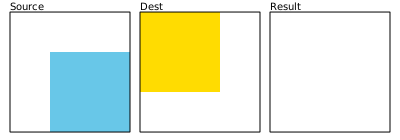
Clear = 0
No regions are enabled.
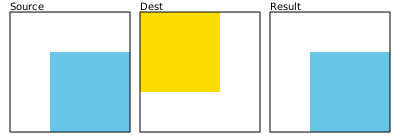
Copy = 1
Only the source will be present.
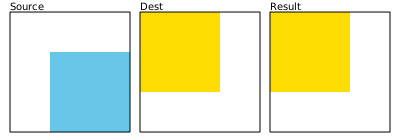
Dest = 2
Only the destination will be present.
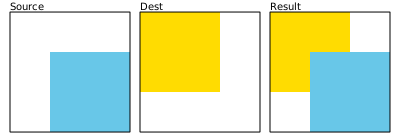
SrcOver = 3
The source is placed over the destination.
DestOver = 4
The destination is placed over the source.
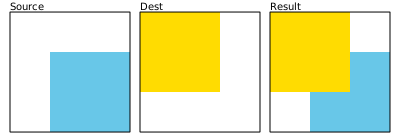
SrcIn = 5
The parts of the source that overlap with the destination are placed.
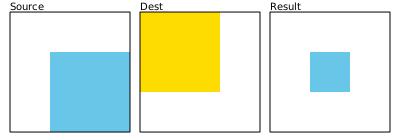
DestIn = 6
The parts of the destination that overlap with the source are placed.
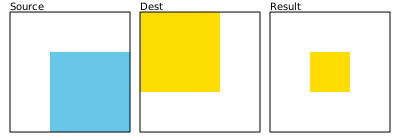
SrcOut = 7
The parts of the source that fall outside of the destination are placed.
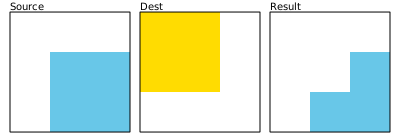
DestOut = 8
The parts of the destination that fall outside of the source are placed.
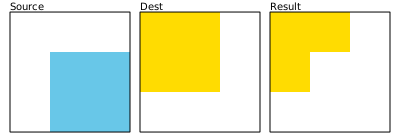
SrcAtop = 9
The parts of the source which overlap the destination replace the destination. The destination is placed everywhere else.
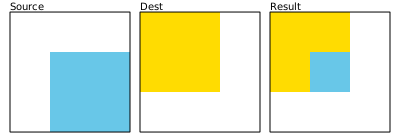
DestAtop = 10
The parts of the destination which overlaps the source replace the source. The source is placed everywhere else.
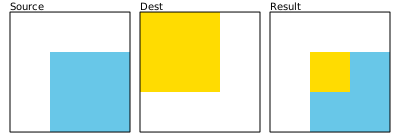
Xor = 11
The non-overlapping regions of source and destination are combined.
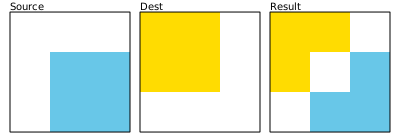
Plus = 12
The sum of the source image and destination image is displayed.
PlusLighter = 13
Allows two elements to cross fade by changing their opacities from 0 to 1 on one element and 1 to 0 on the other element.
Trait Implementations§
§impl CheckedBitPattern for Compose
impl CheckedBitPattern for Compose
§type Bits = u8
type Bits = u8
Self must have the same layout as the specified Bits except for
the possible invalid bit patterns being checked during
is_valid_bit_pattern.§fn is_valid_bit_pattern(bits: &u8) -> bool
fn is_valid_bit_pattern(bits: &u8) -> bool
bits
as &Self.§impl Contiguous for Compose
impl Contiguous for Compose
§fn from_integer(value: Self::Int) -> Option<Self>
fn from_integer(value: Self::Int) -> Option<Self>
value is within the range for valid instances of this type,
returns Some(converted_value), otherwise, returns None. Read more§fn into_integer(self) -> Self::Int
fn into_integer(self) -> Self::Int
C into the underlying integral type. This
mostly exists otherwise generic code would need unsafe for the value as integer Read moreimpl Copy for Compose
impl Eq for Compose
impl NoUninit for Compose
impl StructuralPartialEq for Compose
Auto Trait Implementations§
impl Freeze for Compose
impl RefUnwindSafe for Compose
impl Send for Compose
impl Sync for Compose
impl Unpin for Compose
impl UnsafeUnpin for Compose
impl UnwindSafe for Compose
Blanket Implementations§
§impl<T> AnyEq for T
impl<T> AnyEq for T
Source§impl<T> BorrowMut<T> for Twhere
T: ?Sized,
impl<T> BorrowMut<T> for Twhere
T: ?Sized,
Source§fn borrow_mut(&mut self) -> &mut T
fn borrow_mut(&mut self) -> &mut T
Source§impl<T> CloneToUninit for Twhere
T: Clone,
impl<T> CloneToUninit for Twhere
T: Clone,
§impl<T> Downcast for Twhere
T: Any,
impl<T> Downcast for Twhere
T: Any,
§fn into_any(self: Box<T>) -> Box<dyn Any>
fn into_any(self: Box<T>) -> Box<dyn Any>
Box<dyn Trait> (where Trait: Downcast) to Box<dyn Any>. Box<dyn Any> can
then be further downcast into Box<ConcreteType> where ConcreteType implements Trait.§fn into_any_rc(self: Rc<T>) -> Rc<dyn Any>
fn into_any_rc(self: Rc<T>) -> Rc<dyn Any>
Rc<Trait> (where Trait: Downcast) to Rc<Any>. Rc<Any> can then be
further downcast into Rc<ConcreteType> where ConcreteType implements Trait.§fn as_any(&self) -> &(dyn Any + 'static)
fn as_any(&self) -> &(dyn Any + 'static)
&Trait (where Trait: Downcast) to &Any. This is needed since Rust cannot
generate &Any’s vtable from &Trait’s.§fn as_any_mut(&mut self) -> &mut (dyn Any + 'static)
fn as_any_mut(&mut self) -> &mut (dyn Any + 'static)
&mut Trait (where Trait: Downcast) to &Any. This is needed since Rust cannot
generate &mut Any’s vtable from &mut Trait’s.§impl<T> DowncastSync for T
impl<T> DowncastSync for T
§impl<Q, K> Equivalent<K> for Q
impl<Q, K> Equivalent<K> for Q
§fn equivalent(&self, key: &K) -> bool
fn equivalent(&self, key: &K) -> bool
key and return true if they are equal.§impl<Q, K> Equivalent<K> for Q
impl<Q, K> Equivalent<K> for Q
§fn equivalent(&self, key: &K) -> bool
fn equivalent(&self, key: &K) -> bool
§impl<T> Instrument for T
impl<T> Instrument for T
§fn instrument(self, span: Span) -> Instrumented<Self>
fn instrument(self, span: Span) -> Instrumented<Self>
§fn in_current_span(self) -> Instrumented<Self>
fn in_current_span(self) -> Instrumented<Self>
Source§impl<T> IntoEither for T
impl<T> IntoEither for T
Source§fn into_either(self, into_left: bool) -> Either<Self, Self>
fn into_either(self, into_left: bool) -> Either<Self, Self>
self into a Left variant of Either<Self, Self>
if into_left is true.
Converts self into a Right variant of Either<Self, Self>
otherwise. Read moreSource§fn into_either_with<F>(self, into_left: F) -> Either<Self, Self>
fn into_either_with<F>(self, into_left: F) -> Either<Self, Self>
self into a Left variant of Either<Self, Self>
if into_left(&self) returns true.
Converts self into a Right variant of Either<Self, Self>
otherwise. Read more